This section provides a number of examples of how High End Computing is used, including case studies from HECToR users.
Why is HECToR important?
A short film explaining why HECToR is important.
Do you have a story?
How has HECToR helped your research? Do you have an interesting case study? The HECToR team are keen to hear how the HECToR facility has had an impact on your research. If you are interested in your research appearing on the HECToR website then please contact us via the HECToR Helpdesk and we will be more than happy to help you write it up.
Case Studies
Examples of how HECToR has helpded individual research groups.

Materials Chemistry Consortium Highlights
MCC has played a major role in UK computational science and, since its foundation in 1994, has exploited the latest developments in HPC technologies, in a wide ranging programme of development, optimisation and applications studies aimed at modelling and predicting the structures, properties and reactivities of functional materials, including catalysts, ceramics, minerals and molecular materials. The programme embraces both large scale simulations based on forcefields and electronic structure techniques employing Density Functional Theory, Hartree Fock and hybrid techniques. Strong emphasis is placed on code development and optimisation for MPP platforms while several applications highlight systems of industrial importance. There is strong symbiosis between the modelling studies of the consortium and experimental programmes.
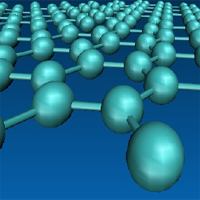
Quantum Monte Carlo and the CASINO program : scaling to hundreds of thousands of computer cores
Availability of petascale computers having tens or hundreds of thousands of cores is opening up completely new possibilities for the techniques of Quantum Monte Carlo. The capabilities of the UK HECToR machine have been fundamental in allowing UK researchers to demonstrate this.
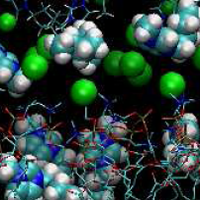
Investigating new green chemical compounds
Room-temperature ionic liquids (RTILs) are being proposed as "green" compounds, clean and safe. However, to fully justify this label, it would be better to understand their effect on basic biological structure, such as the lipid bilayers that surround cells. The computations conducted by scientists at Queen's University Belfast clarify many aspects of these interactions.
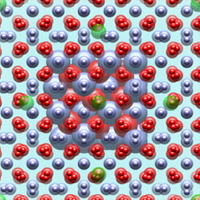
Solving the Mystery of Car Battery's Current
Chemists have solved the 150 year-old mystery of what gives the lead-acid battery, found under the bonnet of most cars, its unique ability to deliver a surge of current. A team of researchers from Oxford University, the University of Bath, Trinity College Dublin, and the ISIS neutron spallation source, have explained for the first time the fundamental reason for the high conductivity of lead dioxide.
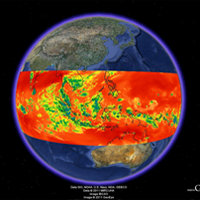
CASCADE: Cloud System Resolving Modelling of the Tropical Atmosphere
Strong surface heating by the sun in the tropics is communicated to the atmosphere through the process of convection; this is responsible for significant amounts of tropical rainfall and plays a pivotal role in the heat and moisture budgets of the tropical climate system. Convection manifests itself through scales from the size of an individual cloud through the mesoscale and up to the synoptic and planetary scales, so in order to represent these scale interactions in a model, it must cover a sizeable fraction of the Earth in order to capture the planetary/synoptic, yet be able to resolve km-sized single clouds. The CASCADE project (NERC Reference: NE/E00525X/1) was devised to investigate these phenomena by means of very large high-resolution simulations.
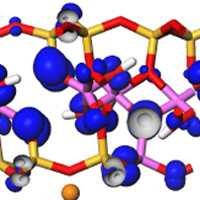
New tricks from old oil: what can biofuels learn from the catalysis of crude oil formation?
The quest for non-fossil based fuels is highly topical to the issue of climate change and yet, to be able to design efficient alternatives - particularly in the form of biofuels - requires an investigation into the formation of fossil oil itself. The exact chemical process of how this organic life, crushed and encased within clay minerals, is converted into oil or hydrocarbons remains inexactly identifed. Determining the stages involved in this process has the potential to beneft the production of biofuels due to the similarity of the molecules that form the hydrocarbons. Such an investigation of a chem ical pathway necessitates an examination of the atoms and their electrons from a quantum mechanical, simulation perspective, which is achievable using density functional theory (DFT), planewaves and pseudopotentials within the CASTEP code. This approach is computationally expensive but feasible due to the facilities provided by HECToR and has resulted in the identi cation of a clay mineral environment that has the catalytic potential to convert a fatty acid into an alkane.
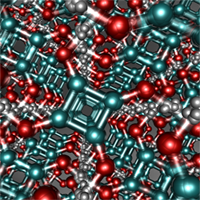
Solving the Mystery of Hydrogen Bonds
Hydrogen (H) bonds are essential to life on earth. Deuterium is the most common isotope of H and when H-bonds involve deuterium rather than H something strange happens: some get longer, some get shorter and some show no change at all. This behaviour has remained an enigma since its first detection in the 1950s. In their paper Li et al. solve this puzzle by showing that the influence isotope effects have - and in essence quantum effects - on H-bonds depends on their strength: strong H-bonds get stronger and weak H-bonds get weaker. This surprisingly simple finding is arrived at on the basis of state-of-the-art computer simulations on the UK’s largest supercomputer (HECToR).

Forecasting Faster: Configuring and Optimising the Weather Research and Forecast Model for Maximum Performance
Understanding and predicting the behaviour of the Earth's atmosphere and weather systems is a very complex problem and has historically always exercised the leading High Performance Computing resources available at any one time. The significant usage of HECToR for atmosphere-related simulation work continues this trend and the Weather Research and Forecast (WRF) Model accounts for a large part of this. In this HECToR dCSE project, scientists have investigated various ways in which the performance of WRF on Phase 2a of HECToR may be improved.
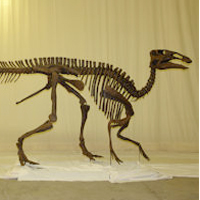
Virtual palaeontology: gait reconstruction of extinct vertebrates using high performance computing
The team of scientists - from The University of Manchester, University of Oregon and Yale have been using HECToR to understand how dinosaurs moved. They found that hopping hadrosaurs were fastest but, for safety reasons, a two-legged running gait was most likely. In addition the team, funded by National Geographic and The Natural Environment Research Council, has shown how more research can be done to find out how large and fast animals moved, both living and extinct.
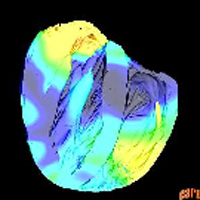
Improving the Modelling of Cardiac Arrythmia
Medical science is increasingly turning to computational models to study the possible effects of drugs and surgical interventions, before moving on to patient trials. One active area of research is in heart modelling. Researchers at the Oxford e-Research Centre (OeRC) and EPCC (University of Edinburgh), will be using HECToR to optimise heart-modelling software. If successful, this work will enable much greater integration of computer simulation with the operating theatre and could, ultimately, lead to personalised medicine.
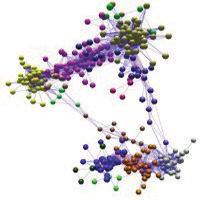
SPRINT - parallel statistics using R
Gene analysis is becoming increasingly complex and can be greatly enhanced by exploiting the power of high-performance computing (HPC), but the software can be difficult for researchers to use. To allow greater access to the benefits of HPC, EPCC and the Division of Pathway Medicine at the University of Edinburgh developed a prototype framework called SPRINT, which allows biostatisticians to more easily exploit HPC systems.
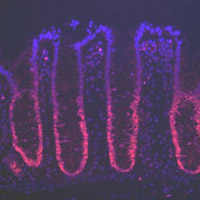
Novel computing in fight against cancer
National Cancer Registration data indicate that some 35,000 people each year are diagnosed with colorectal cancer (cancer of the large bowel and rectum) and 16,000 die from the disease. While the development of effective treatments is clearly important, early identification of patients at risk and prevention is a primary objective of all major cancer agencies and of National Health Service policy. Armed with first access to an unprecedented set of genomic data in colorectal cancer, the University of Edinburgh Colon Cancer Genetics Group (CCGG) and EPCC Supercomputing Centre teamed up to investigate the relationship between genetic markers and colorectal cancer.
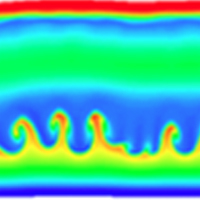
Fasten your seatbelts: Turbulent patches in oceans and atmospheres
The presence of patches of turbulent fluid within atmospheric or oceanic flows is well known (not least to aircraft passengers). Wave breaking is a complex phenomenon and has been quite extensively explored. The subsequent breakdown to a fully turbulent patch, along with the latter's development and (perhaps) eventual decay is not, however, well understood. We have been using HECToR resources to compute such flows, analysing both the transition-to-turbulence process and the fully developed turbulence in the patch.
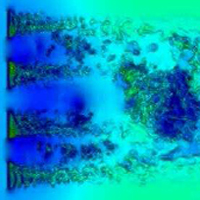
Breakthrough in Fluid Mixing: Simulating Fractal-Generated Turbulent Flows
The first ever successful simulations of turbulence generated by fractal grids (see figure) have been performed on HECToR in 2008 and 2009. The size of these simulations is so large that they are impossible without High Performance Computing. Industries that need to create or minimise turbulence have an interest in this work. They include the chemical and process industries, which use turbulence for mixing, and the aerospace and automotive industries, which need to reduce noise, fuel consumption and pollutant emissions through the control of turbulent flows.
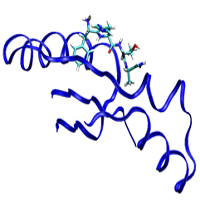
Optimisation of ONETEP Code
ONETEP is currently being used for a wide variety of applications by several UK and international research groups, including studies of protein-ligand interactions and self-assembly in semiconductor nanorods. Recent development work using HECToR and Imperial's CX1 machine has greatly improved the parallel efficiency of ONETEP, especially when studying systems of solids. Recently, calculations involving systems of up to 32,768 of crystalline silicon have been demonstrated and scaling efficiently up to over 256 cores.
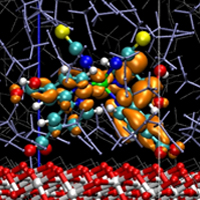
CP2K : High Performance Quantum Chemistry on HECToR
CP2K is a freely available, open source application which uses Density Functional Theory (DFT) to perform ab-initio quantum mechanical calculations on a variety of physical systems. CP2K is heavily used on HECToR - around 50,000 CPU hours are used each month. Substantial performance improvements had been achieved: up to 30% on 256 cores for a small benchmark system of liquid water, and up to 300% on 1024 cores for a larger, non-homogenous system. These improvements are already available to users of HECToR and HPCx via the centrally installed versions of CP2K, and are available to CP2K users worldwide through the CVS repository on the CP2K website.
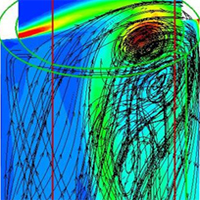
Reducing Noise Pollution from Aircraft
Aircraft pressure relief valves are used to protect the fuel tanks of wide-body civil aircraft from over-pressurization. The relief valve outlet is typically in the shape of a cylindrical hole, or cavity, cut in the underside side of the wing skin. At typical approach speeds of around Mach 0.3, the flow past the cylindrical cavity can become unsteady. This produces an unwanted tonal contribution to the airframe landing noise. A numerical investigation of this phenomenon was performed in consultation with Airbus France, as part of the EU programme AeroTraNet.
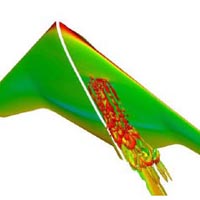
Cavity Flow Studies
As part of the UK 2nd Applied Aerodynamics Consortium and the EPSRC project EP/C533380/1, the Multi-Block solver of Liverpool was used to analyse flows around Unmanned Combat Aerial Vehicle (UCAV) configurations that include bays for stores and sensors. This complex flow problem is usually studied using idealised configurations of flows inside rectangular cavities exposed to a stream of high speed flow. This problem is complex due to the strong interactions between the shear layer formed across the cavity and the acoustic waves radiated from the downstream cavity wall.
Technical Reports
Both the HECToR Computational Science and Engineering (CSE) team and the Cray Centre of Excellence (CoE) have technical reports on work done to enable new science on HECToR.